The right way to judge sauna health benefits is by how it will feel, fit, and hold up after the first month. Heat performance, electrical planning, materials, maintenance, and actual user habits matter more than showroom language.
Last October I helped my neighbor Brian tear out a stock-tank cold plunge he’d set up behind his detached garage in suburban Minneapolis. The tank itself was fine, a $90 Tractor Supply oval. The problem was everything around it. He’d set it on bare soil that froze, heaved, and cracked the PVC drain fitting. His extension cord ran 40 feet to a shared kitchen circuit that tripped every time his wife turned on the KitchenAid. He was hauling 60 pounds of ice from a gas station three times a week. The whole project lasted about six weeks before his wife told him to get rid of it. “I spent more on ice than I would have spent on a real chiller,” he said, pulling the plug on a submersible pump that had already started to rust.
Brian’s experience is, honestly, the norm. Most failed cold plunge builds don’t fail because the owner picked the wrong tub. They fail because the pad, the electrical, and the water maintenance were afterthoughts. This guide is about getting those right.
The Practical Read
A home cold plunge is a legitimate recovery tool when the install basics are done properly. Pick a footprint that fits your space, match the chiller to the tub volume and your local climate, build a pad that won’t settle, and run any 240V electrical through a licensed electrician. All-in costs for most home builds land between $4,500 and $14,000 for a purpose-built unit, or $400 to $900 for a DIY stock-tank setup that requires manual ice. The rest of this piece covers specifications, research, install details, cost, and when to call a pro.
What to Actually Read on a Spec Sheet
Spec sheets trip people up because they mix marketing language with the numbers that matter. Here’s the short list worth checking before you commit to anything.
Tub volume: Most residential cold plunges hold 80 to 120 gallons. That’s enough for a full seated immersion for someone up to about 6’2″. Smaller “solo” tubs at 60 gallons work, but tall users end up with their knees above water, which defeats much of the purpose.
Chiller sizing: This is where Brian’s ice problem gets solved, or doesn’t. A 1/3 HP chiller can hold 50°F in a small insulated tub sitting in a temperate garage. That same unit will struggle badly in a hot garage in August, running almost continuously and burning out within a year or two. A 1 HP chiller is overkill for a mild climate but appropriate in the Sun Belt or for anyone who wants water consistently below 45°F. Read the manufacturer’s sizing chart for your specific tub volume and ambient temperature range. Forum advice is unreliable here because it ignores climate.
Filtration and sanitation: Most modern residential units combine ozone, UV, and a 5-micron filter cartridge. This combination keeps water clear for 6 to 12 weeks between full drains. Stock-tank DIY setups have none of this, which is why they turn green.
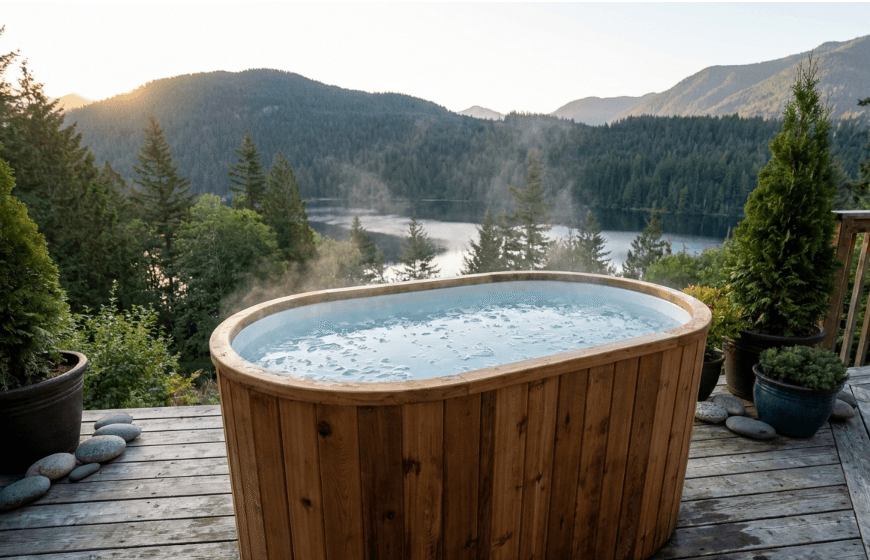
Tub material: Insulated acrylic and rotomolded polyethylene are the residential standards. Commercial-grade stainless steel builds cost roughly twice as much but last significantly longer in outdoor installations. Cedar-clad exteriors look beautiful in year one. By year three in a wet climate, they need serious attention.
What the Research Actually Shows (and Where It Gets Thin)
The recovery literature on cold water immersion is more substantial than most people assume, but also more nuanced than the podcast version suggests.
Heinonen and Laukkanen reviewed cold-water immersion outcomes in 2018 (Frontiers in Physiology) and reported reductions in self-reported muscle soreness, modest improvements in mood, and measurable changes in catecholamine signaling after 2 to 5 minute immersions at 50°F to 59°F. The mood piece is probably the most consistent finding across studies, and it’s the one most home users will notice first.
A 2022 systematic review by Allan and colleagues (European Journal of Applied Physiology) examined cold-water immersion after resistance training and found recovery benefits, but with an important caveat: very frequent immersions immediately after lifting may blunt some hypertrophy signaling. The practical takeaway for home users is straightforward. Keep cold sessions between 2 and 5 minutes. If muscle growth is a primary goal, separate cold exposure from heavy resistance training by at least 4 hours.
Here’s my honest take: the metabolic claims (fat loss, brown fat activation, metabolic rate increases) are the weakest part of the cold-exposure literature. They exist. They’re interesting. But they’re small-effect-size findings in controlled settings, and anyone buying a $7,000 cold plunge primarily for weight loss is likely to be disappointed. Buy it for recovery and mood. If some metabolic benefit comes along, consider it a bonus.
The cardiovascular response is real and deserves respect, not casual dismissal. Cold immersion spikes heart rate and blood pressure within seconds. Adults with arrhythmias, uncontrolled hypertension, Raynaud’s phenomenon, or who are pregnant need to clear cold immersion with a physician before any home use. This isn’t a legal hedge. It’s physiology.
The Pad and Electrical (Where Projects Actually Fail)
A full cold plunge with water, chassis, and one adult can put 800 to 1,200 pounds on a small footprint. That matters.
Pad options: A 4-inch compacted gravel pad with a drainage layer works for many backyard installations on stable soil. A 4-inch reinforced concrete pad is the better call on soft soil, on clay, or in freeze-thaw climates. Brian’s mistake (bare soil in Minneapolis) is an extreme example, but I’ve seen plenty of gravel pads that weren’t compacted properly and started settling within a single season. Budget $400 to $900 for gravel, $1,200 to $2,400 for concrete.
Electrical: Most residential cold plunge units run on a standard 110V outlet with an integrated chiller, ozone, and filtration factory-wired. The owner’s responsibility is a properly grounded GFCI outlet on its own dedicated circuit. If your nearest outlet is more than 25 feet away, or shares a circuit with a refrigerator or shop tools, have a licensed electrician run a dedicated 20A 110V line. Some commercial-grade chillers require 240V, which always means a licensed electrician and usually a permit. Budget $600 to $1,800 for a 240V run.
Water care: Test pH and sanitizer weekly. Replace filter cartridges on the manufacturer’s schedule (typically every 6 to 12 weeks). Drain and refill when the manufacturer says to, not when the water “looks fine.” Biofilm builds in places you can’t see.
What It Actually Costs, All In
The sticker price on the unit is maybe 60% of your real cost. Here’s what the full picture looks like.
Purpose-built residential tubs with integrated chillers: $4,500 to $7,500. Commercial-grade stainless builds with full filtration: $9,000 to $14,000. Stock-tank DIY with manual ice: $400 to $900, plus ongoing ice costs that add up faster than anyone expects.
Add the pad ($400 to $2,400), any electrical work ($600 to $1,800 for 240V), and a first-year maintenance budget for filters, test strips, and water treatment chemicals (roughly $150 to $300).
On the tax side, some home wellness equipment can be reimbursed through HSA or FSA accounts when a Letter of Medical Necessity (LMN) is on file. Services like TrueMed issue LMNs after a short clinician review for conditions where cold therapy is a recognized treatment input. Eligibility is patient-specific and the IRS rules are strict. Talk to your tax advisor before assuming a purchase qualifies.
Appraisers won’t add dollar-for-dollar value to your home for a cold plunge setup. But a well-built outdoor wellness installation is increasingly treated as a selling feature in Northeast and Pacific Northwest markets, similar to how a finished basement or outdoor kitchen gets a nod in a listing without a precise dollar figure.
Comparing Your Options
The boring truth is that the right cold plunge setup depends on your climate, your space, your electrical situation, and (most importantly) the routine you’ll actually maintain.
A purpose-built insulated tub with a 1 HP chiller holds 39°F to 45°F all day, no ice runs, no daily fuss. It’s the option that gets used consistently. A stock-tank DIY can hit the same temperatures, but you’re buying and hauling bags of ice, and the water quality degrades fast without filtration. A chest-freezer conversion is the cheapest functional option, but it lacks proper filtration, the ergonomics are awkward, and it’s mechanically marginal at best.
If you want a deeper walkthrough comparing specific model lineups and price tiers, there’s a useful long-form reference at https://sweatdecks.com/blogs/news/sauna-health-benefits that covers specs, install, and pricing in more detail. Worth bookmarking before you start a build.
When to Call a Pro (and When to Call Your Doctor)
Three moments where professional help pays for itself:
The pad. Especially in freeze-thaw climates or on soft soil. A pad that settles or cracks is dramatically more expensive to fix with 1,000 pounds of water sitting on top of it.
The electrical. Any 240V work. Any circuit where you’re not 100% sure of the amperage, grounding, or GFCI protection. This is not a YouTube-tutorial situation.
Your health. If you have an arrhythmia, uncontrolled hypertension, a recent cardiac event, Raynaud’s phenomenon, are pregnant, or are managing a chronic condition, a 10-minute conversation with your physician is the right first step. The research is encouraging for healthy adults. It is not a universal green light.
FAQs
Do I need a permit for a cold plunge?
The plunge unit itself rarely requires a building permit if it’s a freestanding appliance. The electrical permit for a 240V circuit is almost always required. Some municipalities also have setback or drainage requirements for outdoor water fixtures. Call your local building department before ordering.
How long does a chiller take to cool down a freshly filled tub?
Depending on chiller size and starting water temperature, expect 3 to 8 hours to pull a freshly filled tub from tap temperature down to 45°F. After that initial cooldown, a properly sized chiller maintains temperature with minimal cycling.
How long should a cold plunge session last?
Most adults do well between 2 and 5 minutes at 40°F to 55°F. Build up gradually if you’re new. The Heinonen and Laukkanen review found benefits at exposures as short as 2 minutes.
Can I install a cold plunge on a deck?
Some smaller units can sit on reinforced decking if the framing supports the loaded weight (often 600 to 1,200 pounds). Confirm load capacity with a structural engineer or contractor before placing a unit on existing decking. Most full-size units belong on a ground-level pad.
How often does a cold plunge need maintenance?
Replace filter cartridges every 6 to 12 weeks. Run ozone or UV on the manufacturer’s schedule. Test pH and sanitizer weekly. Drain and refill per the manufacturer’s interval, typically every 8 to 12 weeks with proper filtration, sooner without it.
Is a stock-tank DIY setup worth it?
It can be a reasonable way to test whether you’ll actually use cold immersion before investing in a purpose-built unit. But budget for ongoing ice costs, accept that water quality will be inconsistent, and know that most people who stick with cold plunging long-term eventually upgrade.
Can I use a cold plunge year-round in a cold climate?
Yes, but with caveats. In sub-freezing climates, you’ll want an insulated tub with a chiller that also has a heating element to prevent freeze damage during extended non-use. Some owners keep a tub running year-round because the ambient cold actually reduces chiller workload. Others winterize and drain. Your call.
Disclaimer. This article is general consumer information, not medical advice. Cold-water immersion carries real cardiovascular load. Anyone with arrhythmias, uncontrolled hypertension, Raynaud’s phenomenon, recent cardiac events, or who is pregnant should consult a physician before starting any new cold-plunge routine.
HSA and FSA reimbursement on wellness equipment is patient-specific and depends on a Letter of Medical Necessity from a clinician. Talk to your tax advisor before assuming a purchase qualifies.